In the intensely competitive world of contemporary serious sliding, podium finishes is no longer exclusively a result of brute horsepower or behind-the-wheel bravado. Rather, it is now a complex discipline which demands a painstaking blend of picking a proven vehicle platform, arming it with the highest-quality drift-spec parts, and, most critically, understanding its real-time characteristics on the course through advanced suspension tuning applications. This definitive guide acts as your blueprint starting from the very first idea of a drift build all the way to the final telemetry-optimized refinements that turn a powerful machine into a predictable podium finisher. We will thoroughly explore the methodical process of car suspension tuning, illustrating how a state-of-the-art vehicle dynamics tool like precise measurement hardware eradicates approximation and offers exceptional insight into your vehicle's true performance.
The foundation of any great drift car is, without question, the chassis itself. Certain platforms have achieved renowned standing within the global sliding scene due to their built-in balance, strong build quality, and the enormous availability of aftermarket parts available. Choosing the optimal starting point is the first and most crucial choice a enthusiast will make. To illustrate, the the E36 generation BMW is widely regarded as one of the finest overall drift platforms of the modern era. Its near-perfect evenly distributed mass, coupled with a RWD layout and extremely reliable six-cylinder engines, establishes a car that is both accessible for newcomers and highly competitive in the possession of a professional driver. The successor of this philosophy, the BMW E46, improves on these qualities with a more sophisticated structure, increased track for greater high-speed stability, and even increased lock as standard from the manufacturer. Another powerful contender in the pro arena is the Corvette C6.
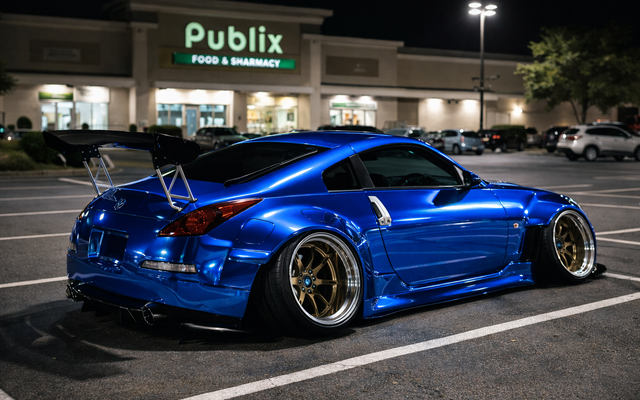
This American track weapon brings a particular set of strengths to the drifting discipline, including a light alloy frame, a rear-mounted transaxle that helps create an perfect balance, and the immense thrust of a powerful LS V8 motor. This combination transforms it into an utter weapon on track, designed of starting and maintaining continuous slides with seemingly minimal use of throttle. For drivers looking for exceptional performance per dollar, the 350Z model Nissan excels as a excellent candidate. It comes from the manufacturer with a rigid body structure, a effective factory limited-slip differential, and the smooth VQ35DE engine that delivers plenty of performance for mastering and advancing in the activity. Its successor, the Nissan 370Z, brings more improvements in chassis stiffness, suspension design, and overall powerplant performance, cementing its place as a popular selection among professional pilots. Other legendary cars that merit consideration are the agile unique Mazda FC RX-7, the ubiquitous Nissan S13 240SX, the V8-powered SN95 generation Mustang, the more recent E90 3 Series, and the tiny yet unbelievably engaging and forgiving Mazda Miata. All of these platforms offers a unique set of attributes, challenges, and capabilities, but they all possess the fundamental elements necessary to be transformed into a serious drift car.
However, choosing the optimal platform is merely the first step. To access the true potential of every of these cars, significant changes to the steering system and suspension systems are absolutely mandatory. This is where the domain of performance tuning components becomes critical focus. The one most impactful improvement for a serious drift car is the integration of a high-performance angle modification kit. These engineered assemblies, for example those manufactured by performance brands like specialist manufacturers, are created to significantly expand the car's available turning lock. A factory street car is severely limited in how far its tires can pivot, a engineering trade-off for on-road use. In drifting, conversely, maximum steering input is constantly necessary to control and sustain a slide. An steering kit substitutes the stock steering knuckles, tie rods, and often A-arms with pieces that allow the wheels to reach degrees of turn over 70 or even 80 degrees, compared to a average factory angle of around 40 to 50 degs.
This tremendously expanded steering angle offers the driver with significantly greater control during a slide, making it considerably easier to begin a slide, hold it through a long bend, and transition fluidly from one direction to the other. The improvement in handling is truly profound. Combined with a correctly chosen steering kit is the just as essential upgrade to the vehicle's suspension. Off-the-shelf or including expensive road adjustable suspension are just not designed for the unique and extreme needs of sliding. A purpose-built set of coilovers is of utmost importance. These engineered dampers feature custom piston tuning and spring stiffness that are optimized for the extreme mass transition that is inherent of drifting. When a operator begins a slide, the car's inertia is thrown violently to the outer of the turn. Optimal competition coilovers control this movement in a controllable manner, allowing the chassis to settle quickly and providing the pilot precise feel through the controls and cockpit. They furthermore provide accurate setting of ground clearance, shock absorber firmness, and corner weighting, which are all key parts of optimizing the vehicle's dynamics to a specific circuit or competition technique. In combination, a precision-engineered drift angle kit and a correctly selected set of drift-spec adjustable dampers constitute the core mechanical base upon which all subsequent tuning is constructed.
Once the fundamental hardware is fitted, the subsequent vital stage in the project is the detailed setting of the car's alignment. This is the world of car suspension tuning, a methodology that can appear intimidating to the uninitiated but is, in fact, the key to turning a assembly of capable pieces into a cohesive and controllable machine. The most discussed aspect of alignment for sliding is definitely negative camber. Camber is the inclination of the tire in relation to the upright axis when viewed from the front of the vehicle. When the upper part of the tire is tilted towards the car, this is called camber-in. For oversteer driving, an inward tilt on the steering tires is generally used and is seen as essential. The purpose is deeply tied to physics.
When a vehicle is cornering at extreme slip angles, the frame rolls toward the outer of the turn. This body roll causes the outside front wheel to lose its optimal grip area with the asphalt. By introducing an inward tilt, the tire is pre-tilted to compensate for this tilt. As the chassis tilts into the bend, the outside front tire gains a better contact patch on the road surface, optimizing its grip at the critical time when it is most required for control. Usually, front angles for a dedicated sliding vehicle range from approximately -3 degrees to as high as -5 degrees or even more, contingent on the details of the car setup, rubber selection, and pilot style. The back wheels also employ inward lean, but the settings are typically more conservative and more nuanced than the front axle. Overly aggressive negative camber at the rear can cause the vehicle to excessively prone to oversteer and hard to predict on power application, as it reduces the effective grip area of the driving wheels during straight-line acceleration. Therefore, rear camber settings are often in the range of -1 degree to -3 degrees, striking a delicate balance between offering enough lateral bite to assist in initiating and sustaining the slide while still keeping good traction for exiting the turn. Camber is merely one part of the larger tuning equation, which also involves toe setting, caster angle, and bump steer modification.
Toe angle is the direction of the wheels when looked at from above. Positive toe means the front edges of the tires are nearer together than the rear edges, while toe-out means the opposite. For oversteer, a slight amount of front toe-out is commonly employed to quicken the initial directional reaction, making the vehicle feel more agile and ready to start a slide. Rear axle toe setting is typically set to neutral or a extremely slight amount of positive toe to foster predictability under acceleration. self-centering is the frontwards or rearward inclination of the kingpin axis when looked at from the side-on of the vehicle. Positive caster enhances self-centering and high-velocity confidence, and it additionally increases negative camber effect during steering, which is very beneficial. Adjusting these values is a detailed interaction where a change to one value can and often will affect the others. The conventional approach for tuning a car's suspension geometry for sliding has long been a tedious endeavor of experimentation and feeling. A tuner or engineering group would introduce a modification based on a hunch, run the vehicle on track, use the pilot's personal feel and feedback, and then make an additional tweak. This process would continue again and again until the vehicle felt "good" or the available practice period was exhausted. This approach is not only incredibly wasteful in terms of man-hours and tires, fuel, and parts, but it is additionally fundamentally flawed.
Pilot perception is a famously subjective measurement tool, influenced by countless factors such as fatigue, changing track conditions, temperature, and simply the mood of the driver on that particular run. What feels "tail-happy" on one pass might feel "pushing" on the subsequent pass, causing contradictory information and ineffective changes. This long-standing problem in vehicle dynamics optimization is exactly where modern technology has stepped in to revolutionize the process.
The rise and adoption of specialized drift telemetry software has ushered in a new age for engineering and refining professional sliding vehicles. This new generation of platforms, showcased by cutting-edge systems like GripDial, function by directly measuring the real-time physical behavior of the chassis as it is piloted on the course. As opposed to using driver feedback, these systems collect quantifiable information on key factors such as suspension travel, individual tire rotation, acceleration forces, lock position, and throttle and brake position. This collected telemetry is then interpreted by sophisticated software that can visualize and interpret the data in a comprehensible way. For the very first time, drivers and builders can visualize specifically what the chassis drift tuning app is exhibiting at each point of a lap. This function transforms the complete suspension tuning process. Consider the aforementioned goal of optimizing the front axle camber for a specific chassis. As an alternative to making a adjustment from -3 degrees to -3.5 degrees and then testing many laps to try and "feel" a change, a telemetry system can give immediate and clear data. The tool can indicate graphically how the wheel's contact patch is performing during the key phases of a drift: turn-in, mid-corner, and transition. It can demonstrate if the present angle is allowing the loaded tire to keep ideal contact or if the rubber is overloaded on its external shoulder.
The system can then suggest fact-based suggestions for adjustment. Perhaps the data reveals that the tire is even overworking its outer shoulder at -3.5 degrees of negative camber, indicating that even more angle, say -4 degrees, might be beneficial. Alternatively, the data might show that the tread is not achieving heat or that the inner shoulder is degrading unevenly, which could point to that there is too much angle and a modest reduction back to -3.2 degrees would be better ideal. This level of accuracy and practical analysis was simply unimaginable in the era of pure seat-of-the-pants tuning.
The impact of using a comprehensive vehicle dynamics tool goes much further than merely optimizing alignment. It functions as an essential damper adjustment manual that is tailored to your specific car. When adjusting the damping clickers on your coilovers, rather than using imprecise tips or replicating another driver's numbers, you can utilize the telemetry to observe how the car is behaving in relation to your tweaks. The tool can graph drift angle kits the suspension travel trace over a section of track, showing if the dampers are managing the chassis motion effectively or if they are permitting the vehicle to oscillate uncontrollably after a transition. It can assist in pinpointing problems like excessive compression or topping out, enabling you to apply data-backed choices to spring preload, damping rates, or ground clearance. This process extends similarly to the detailed art of suspension geometry optimization. In addition to camber angle, the tool can give data into how changes to toe and caster are affecting the vehicle's stability during different phases of a slide. For example, it can assist you to find the ideal amount of front axle toe out for your particular steering setup and driving style by showing the quickness of initial response and the consistency of the car at full steering angle. This transforms the software an incredibly useful vehicle dynamics manual that is actively informed by the actual behavior of your specific car on the tarmac. It shifts the entire endeavor from a mysterious craft into a repeatable engineering exercise.
Moreover, the utility of a system like GripDial is not at all restricted to expert teams with large resources. For the amateur enthusiast, it acts as an incredible educational tool. It effectively offers the builder with the analysis of a professional suspension specialist without requiring the typical cost. It accelerates the development time by delivering clear answers to questions that would traditionally take countless track days of experience to answer. A builder can understand how their particular car reacts to different inputs, developing a deeper comprehension of suspension theory in the endeavor. It additionally democratizes high-level suspension engineering principles, enabling every enthusiast with the desire to optimize their vehicle to achieve it in a efficient and successful fashion. This is notably valuable in a activity like oversteer competition, where engineering knowledge has historically been a tightly held advantage among professional teams. Now, that vehicle dynamics tool power can be in the toolkit of any dedicated builder.
In conclusion, the journey to constructing and optimizing the ultimate competitive drift machine is a multi-faceted endeavor that seamlessly integrates classic mechanical principles with cutting-edge digital technology. It begins with the strategic pick of a legendary car, then built upon the application of non-negotiable competition hardware like drift-spec steering angle kits and correctly valved drift-spec adjustable dampers. The process then progresses into the precision realm of alignment optimization, where settings like camber angle, toe, and caster are meticulously set to suit the car's modified geometry and the pilot's individual technique. Ultimately, and what genuinely distinguishes the modern approach from the past, is the integration of a sophisticated drift telemetry software. This platform eradicates the approximation and waste of solely feel-based tuning by providing empirical, actual telemetry on how the chassis is really performing. It functions as an incredible suspension tuning tool, a comprehensive drift suspension tuning guide, and a master vehicle dynamics tool. Together, this holistic methodology leads to that all component of the competition vehicle—from the choice of the platform to the final click on the damper—is perfected for ultimate competitiveness on the circuit. It signifies the full evolution of the art of sliding, merging raw driving skill with data-informed chassis dynamics to build the most dominant cars imaginable.